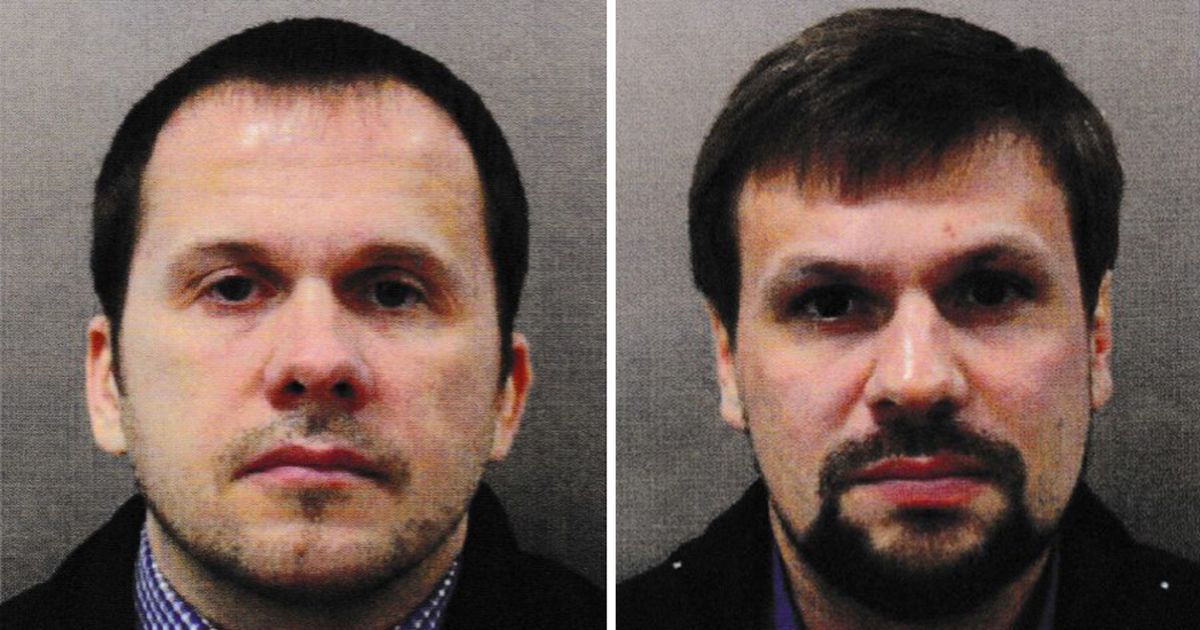
Alexander Petrov and Ruslan Boshirov took up false identities and used a slew of false documents to work their way across Europe, new documents released by counterterror cops show

The Russian poisoners who carried out the attempted assassination of Sergei and Yulia Skripal wove a tangled web of deceit that allowed them to carry a deadly nerve agent thousands of miles before dispensing it in Salisbury.
Alexander Petrov and Ruslan Boshirov – real names Alexander Mishkin and Anatoliy Chepiga – travelled from Moscow to London while hauling Novichok, a Russian poison, which they deployed in Salisbury on March 4, 2018, in a bid to kill the two former agents. An inquiry into the death of Dawn Sturgess, who died when her partner gifted her a perfume bottle which, unbenknownst to him, contained traces of the poison, found today that Vladimir Putin was “morally responsible”.
The two men who carried out the poisonings, evidence presented to the inquiry found, had deep links to the Main Directorate of the General Staff of the Armed Forces of the Russian Federation, otherwise known as the GRU, and used false documents to jet across Europe.
READ MORE: Salisbury poisoners’ movements through London after smuggling Novichok on planeREAD MORE: Sergei Skripal ‘fell asleep at moment of death and woke up 3 weeks later’
Records submitted to the inquiry, which was chaired by Lord Anthony Hughes of Ombersley, showed that both Petrov and Borishov had worked in an official capacity for the Russian intelligence agency.
The records, from the UK’s Counter Terrorism Operations Centre (CTO), which was investigating the Salisbury incident, showed that Boshirov was, in reality, a GRU colonel named Anatoliy Chepiga. Investigators found that, when applying for visa applications, however, he had posed as a systems administrator.
The report states: “As part of Boshirov’s visa applications made to the Netherlands, he stated that he worked for a company called Service VIP. On both occasions, he provided supporting letters, which were signed.”
“Copies of these have been obtained through an EIO submitted to the Netherlands. In the letter supplied with the March 2016 visa application, dated 29 March 2016 he provided a letter stating that he had worked for the company “Service VIP” as a Systems Administrator for more than one year and he listed six months wages.This showed a February 2016 wage of 70000 Roubles.
“A near identical letter supplied in August 2016, dated 23 August 2016, shows his February 2016 wage as being 120000 Roubles. On applying for a UK visa in 2017, he provided a letter saying that he had worked at “Energoforsazh” as a Development Director since 1 September 2011 and was paid a monthly salary of 300000 Roubles.”
Additional documents revealed that Petrov was really a GRU doctor, with the CTO saying he was “assessed as being Alexander Mishkin”.
He had also posed in other positions when producing applications to travel to other nations, twice as a manager and once as a marketer.
The CTO report said: “As part of Swedish Schengen Area visa applications made on 21 January 2014 which has been obtained evidentially by way of an EIO, Petrov and Fedotov provided letters of employment from a company called ‘Mitel’ IMoron in Cyrillic). This stated that he had been an employee there since 13/03/2012 and that he was paid 45,000 Roubles a month.
“He described himself as a ‘Manager’ on the paperwork. When he applied to the Netherlands for visas in 2016, he provided a letter listing him as a ‘Marketer’ for a company called “Akvatekhnika” saying he had worked there since 1 October 2013.”
“He listed his monthly income as being 60,000 Roubles. When he applied to the UK for visas in 2016, he provided a letter listing him as a ‘Manager’ for a company called ‘Di-TekTraid’ saying that he had worked there since 16 March 2015.
“It listed his monthly income as being 135,000 Roubles on the latter of the two applications. On the former, he said that his income was 130,000 Roubles.” Passport photos included in the document further cemented the false identities, and the CTO provided evidence of banking errors that were evidently “false and were created in order to support the false personas”.
The CTO concluded: “As part of the Dutch visa applications in August/September 2016, Petrov and Borishov provided two letters, ostensibly from Sberbank Russia.”
“These were stamped and signed. Both account numbers on these letters are identical, and both letters are from the same branch. Each letter attributes the account to the person who submitted the visa application. The accounts were apparently opened on different dates with the exact same deposit amount, down to the kopek.
“This clearly suggests that these letters are false and were created in order to support the false personas.”