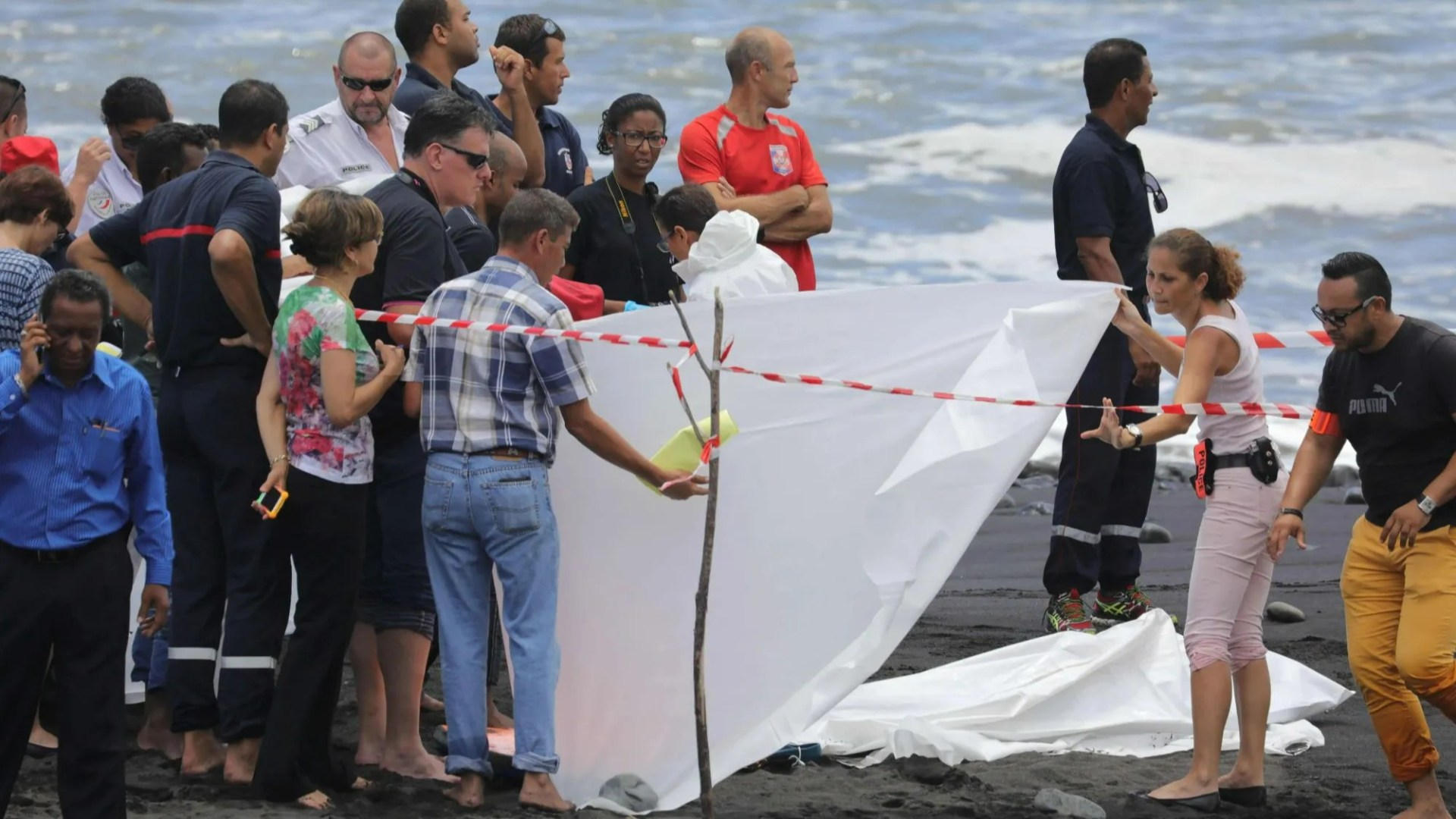
Inside deadliest ‘shark highway’ off honeymoon island where girl was ripped in half and Brit’s hand found inside beast

AN idyllic honeymoon hotspot is so infamous for fatal shark attacks that swimming and surfing are banned.
La Réunion, an island normally associated with white sandy beaches and crystal clear waters, sits on the treacherous stretch of water grimly dubbed “shark highway” in the Indian Ocean.
Swimming and surfing bans have been in place since 2013 as officials battle with “la crise requins,” or the shark crisis, that has given the tropical escape one of the world’s deadliest coastlines.
The island has a fatality rate that dwarfs other shark hotspots like the US, Australia and South Africa.
Between 2011 and 2019, La Réunion accounted for a whopping 18.5 per cent of known global shark fatalities, damaging the island’s crucial tourism economy in the process.
Some 30 people have been killed and 56 mauled while swimming off the island since records began in 1913.

WAR FEARS
Venezuela’s president’s jet heads for border after Trump said airspace CLOSED

PEACE HOPES
Top Ukrainian officials head to US for peace talks hours after Russia’s attack
Marine biologist Arnault Gauthier, whose family has called Réunion home for almost 200 years, says the crisis has “taken away Réunion’s identity”.
A wave of vicious shark attacks plagued the island in the 2010s – with nine confirmed kills in just eight years.
In 2015, the life of a talented teenage surfer was tragically cut short by the seventh gruesome shark attack in only four years.
Elio Canestri, 13, was attacked while surfing only 15 metres offshore.
The boy’s limbs and part of his stomach were sheared off by a shark lurking in the shallow waters.
Two years earlier, a 15-year-old girl was killed while snorkelling just metres off shore near Saint Paul on the island’s west coast.
Sarah Roperth’s body was torn in two at the torso, with part of the body dragged to the depths by the shark.
Following the attack, St. Paul resident Jean-Philippe claimed that a ban on dive fishing in the area had allowed sharks to flourish – leading to a greater number of attacks.
He told French media: “The population suffers to see this child eaten by a predator on the edge of the shore.
“This little girl was not a tourist. Her father has lived on Réunion for a long time and she has swam here since childhood.
“But she had not been told that the island had changed… it is as if it had put poison in the sea without notifying anyone.”
Brit ex-pat Bishop Talon was also torn apart while swimming with friends in waist-high water.
The 22-year-old was eventually pulled to shore, but ultimately succumbed to her catastrophic wounds.
The horror continued in 2019 when French tourist Kim Mahbouli, 28, and Brit Richard Martyn Turner, 44, were killed in separate attacks.
The hand of dead Brit was later discovered in the belly of a belligerent tiger shark, which his wife was able to identify with his wedding ring.
Turner was described as “a very English eccentric” from the Manchester area.
He had been snorkelling alone in an area where four 3 to 4m long sharks were later caught.
Since 2019, there have been no more confirmed killings on the island – which experts say is partly due to the ban on swimming and surfing.
Francois Taglioni, a professor at La Réunion University, told The Sun there was a peak in deaths between 2011 and 2019 – but the situation has been “paradoxical” since.
He said: “During the peak period of interactions, the ocean was open to all water sports enthusiasts and the population of bull and tiger sharks was undoubtedly higher than it has been since 2019.
“The bans on access to the sea since 2013 and shark culling are undoubtedly factors that explain the current situation.”
Taglioni believes there is a divide between those who believe that sharks should be culled to protect humans.
He said: “Sharks in Réunion Island, as in many countries around the world, are perceived through the prism of films such as Jaws and therefore tend to be seen as predators of humans.
“Nevertheless, there are those who believe that sharks must be protected at all costs and that humans should stay away from the sea where there is a risk of interaction.
“And there are those who believe that human life is far superior to that of sharks and that the presence of sharks in waters occupied by humans should therefore be limited as much as possible.
“These two points of view are far apart, and it is generally difficult to reconcile conservationists and supporters of shark culling.”
A 90-shark cull was green-lit in 2013 after the spate of deadly attacks and a proliferating population of the predators.
Taglioni believes this strategy can only ever be short-term.
He said: “Initially, it is clear that if you regulate the shark population in the sea, there will be fewer interactions.
“In the long term, culling sharks would endanger certain shark species that are already threatened by humans.”
French veterinarian Eric Clua condemned the culls.
Speaking to The Sun, he said: “I think we dealt with the problem in the very wrong way. Because human beings are not a natural prey for sharks.
“Instead of culling sharks blindly, we should be looking for the problem individuals – and we could do that. But instead, we are blindly killing animals.”
Dan Duane, host of “Réunion: Shark Attacks in Paradise”, described the bull sharks responsible for the spate of attacks as “f***king horrifying things”.
He told the New York Post: “The French call them bulldog sharks, but pit bull is more appropriate. They thrash and tear. These are f***king horrifying things.
“In the space of two months, on this small stretch of sand, one guy [got] a leg bitten off, two guys [got] chewed to pieces, another guy [got] his canoe bitten in half. And the same thing replicates year after year.”
What makes tiger and bull sharks so deadly?
THE two most feared predators that lurk on La Reunion’s shores have recorded 65 unprovoked fatalities worldwide.
Tiger sharks are large, blunt-nosed sharks that can weigh between 850 to 14,00 pounds.
They have earned a reputation as man-eaters and are only second to great whites in number of attacks and kills.
They are likely to swim away after taking a bite out of people.
Bull sharks are aggressive, medium sized sharks that weigh between 200 and 500 pounds.
They get their name from a short, blunt spout and a tendency to head-butt prey before attacking.
They are third most likely to attack humans behind tiger sharks and great whites and can swim in salt AND fresh water.
They are often found lurking in shallow, warm and turbid waters.
In response to the deepening crisis, scientists flocked to the island to try and understand the behaviour of the apex predators.
Between 2011 and 2015, the French government pumped close to one million euros into a programme dedicated to researching the two most fearsome species – bull and tiger sharks.
Taglioni said: “These two sharks are very well adapted to interactions with humans, which is why their bites are so dangerous.”
Data from tagged bull sharks showed they were present year-round and lurk close to the shore frequently during the afternoon – when the majority of attacks occurred.
Taglioni believes the rapidly increasing population has created conditions that favour the presence of bull sharks.
He explained: “This rapid growth has been accompanied by more water sports enthusiasts, who discharge organic matter from wastewater that ends up in the sea.
“This pollution will cause the water to become more turbid, and turbidity is a factor that favours the presence of bulls in particular.”
Water becomes “turbid”, or cloudy, when silt from the seabed is thrown up by activity, making it difficult to see a shark lurking.
But tiger sharks were shown to be seasonal visitors who prefer offshore waters, though they can be just as vicious.
Professor Erwann Lagabrielle has made it his mission to figure out why the waters around Réunion are so dangerous, 9News reports.
His research shows the probability of being attacked by a shark at Réunion increased “by a factor of 23” since the 1980s.
He wanted to understand the island’s deadly riddle after witnessing his friend being attacked by a two-metre bull shark in 2015.
“It was like a horror movie,” he said.
While the pals were swimming at Saint-Leu, Dr Lagabrielle saw his friend Rodolphe Arriéguy get attacked just 20 metres from him.
“The water was white foam and then the white turned to pink and the pink turned to red,” he said.
“I swam to my friend and that was the most frightening thing – I was swimming against my own instinct.”
With no fatal attacks since 2019, the island of Réunion may begin to let out a collective sigh of relief.